

What Happens During a Dental Implant Procedure, Step by Step
A dental implant is placed in stages: an exam and 3D scan, a written plan, any preparation such as an extraction or bone graft, placement of the implant post, a healing period while the bone fuses to it, and finally the crown, bridge or full arch. The number of visits and the timeline depend on your bone, gums and how many teeth you are replacing.
This article is general education, not a diagnosis or treatment advice. Only an exam and imaging can tell you what your own treatment involves.
Key takeaways
- The American Dental Association describes three general phases: placing the implant in the jawbone, healing while the bone grows around it, then attaching the replacement tooth or teeth.
- Healing (osseointegration) is the longest part. The ADA says it can take up to several months, and the FDA says several months or longer.
- Extractions, gum treatment or bone grafting are only added when your exam shows they are needed, and they add time.
- At Clio Dental Studio, every implant case starts with a cone beam CT scan, and you receive a written plan with the full sequence and transparent costs before any work begins.
- Dr. Sanaz Rouhani, DDS, FAGD sees you at every visit, from consultation to final restoration.
The dental implant procedure at a glance
Clio Dental Studio's dental implant page lays out the process in six steps:
- Consultation and cone beam CT scan
- Your written care plan
- Preparing the foundation, if needed
- Implant placement
- Healing
- Your final teeth
Not every patient goes through every step. Step 3 only happens when your scan and exam call for it, and the length of step 5 differs from person to person. Here is what happens in each one.
Step 1: Consultation and cone beam CT scan
The first visit is an exam of your teeth, gums and bite, plus a cone beam CT scan. The scan maps bone volume, density and nerves in 3D, which is how Dr. Rouhani knows what your anatomy allows, including whether you need a bone graft before an implant can be placed.
This is also the time to talk about your health history. The ADA notes that your general health matters more than your age, that you may be medically evaluated by a physician before implant surgery, and that chronic illnesses such as diabetes or leukemia may interfere with healing. The FDA adds that your overall health affects whether you are a good candidate, how long healing takes and how long the implant may stay in place.
Bring your questions, including any worries about the chair. The consultation and scan involve no surgery.
Step 2: Your written care plan
After the scan, you receive a written plan with the full sequence of treatment and transparent costs before any work begins, and no pressure to decide before you are ready. The plan tells you which steps your case includes, which type of restoration fits, and your own timeline.
The FDA recommends talking with your dental provider about the potential benefits and risks before choosing implants, and asking which brand and model of implant system will be used so you can keep that information for your records. Your plan review is a good moment to ask both.
Step 3: Preparing the foundation, if needed
Some cases start with an extraction, gum disease treatment or a bone graft to rebuild volume. These add time, but they give the implant a stable base.
Why each one comes first:
- Extraction. A broken or failing tooth may need to come out before an implant can take its place.
- Gum treatment. Healthy or treatable gums are part of being a good implant candidate. Uncontrolled gum disease needs attention first, and the FDA lists untreated periodontal disease among the risks associated with implant systems.
- Bone grafting. Bone loss from missing teeth, gum disease or years of wearing dentures does not rule you out. It means the plan includes grafting or an approach like All-on-4, which angles the back implants to reach denser bone.
If your scan shows healthy bone and gums, this step may be skipped entirely.
Step 4: Implant placement
The ADA describes this phase simply: the dentist surgically places the implant into the jawbone. At Clio, the implant post is placed using the plan built from your scan, and in-office technology, including digital scanning and 3D printing, supports precise placement and fit. Placement is done with the area fully numbed, and Dr. Rouhani explains what to expect for your case before treatment.
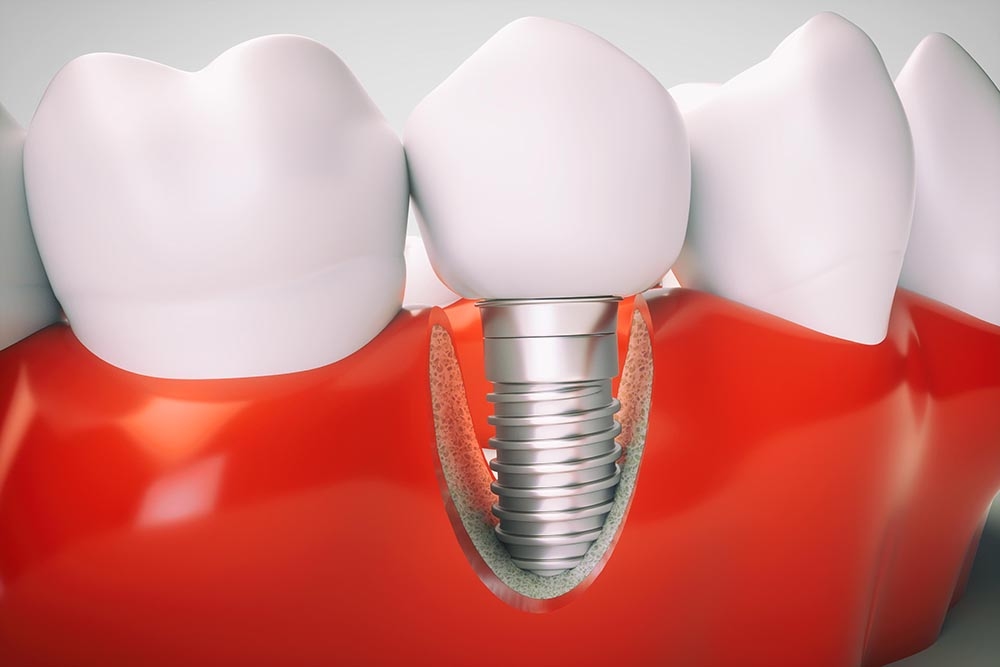
According to the FDA, an implant system has two main parts: the implant body, which is inserted into the jawbone in place of the tooth's root, and the abutment, which attaches to it and extends through the gums to support the replacement tooth.
If you feel anxious, say so when you book. Dr. Rouhani is sedation certified for patients who feel anxious about treatment, the practice takes a judgment-free approach, and the office offers noise-canceling headphones.
Step 5: Healing
Healing is where the implant becomes part of your jaw. The bone around the implant grows around it and holds it in place, a process called osseointegration. The ADA says this can take up to several months before replacement teeth are attached, and that some patients can have implants and replacement teeth placed in one visit. The FDA describes the healing period as several months or longer.
You are not left without teeth while you heal. Temporary options are planned so you can eat and smile in the meantime, and for All-on-4, a temporary arch can often be placed on the day of surgery.
What the official sources say about this stage:
- Food. The ADA says your dentist may recommend a diet of soft foods, cold foods and warm soup during healing.
- Smoking. The FDA says smoking may affect healing and decrease the long-term success of the implant, and the ADA notes that tobacco can slow healing.
- Hygiene. The FDA advises carefully following the oral hygiene instructions your dental provider gives you, because regular cleaning of the implant and surrounding teeth is very important for its long-term success.
- Warning signs. The FDA says to tell your dental provider right away if your implant feels loose or painful.
Your own aftercare instructions come from Dr. Rouhani and are based on your case. If something feels wrong, call the practice at (713) 933-0102. Clio reserves daily emergency slots for patients in pain, and walk-ins are welcome.
Step 6: Your final teeth
Once you have healed, your custom crown, bridge or full arch is attached and adjusted to your bite. The ADA explains that a single-tooth crown is customized for size, shape, color and fit so it blends in with your other teeth, and that replacement teeth take some time to make, so a temporary crown, bridge or denture may be used until the permanent one is ready.
After treatment, the FDA recommends regular visits with your dental provider.
How the path changes with the number of teeth
The six steps stay the same, but what is placed in step 4 and attached in step 6 depends on what you are replacing. Clio offers four implant options:
- Single tooth implant. One implant post, an abutment and a lifelike crown replace one missing tooth. Unlike a traditional bridge, the teeth on either side do not need to be reshaped.
- Implant-supported bridge. When several teeth in a row are missing, two implants can anchor a bridge that replaces them all, without relying on your healthy natural teeth for support.
- Implant-supported dentures. A denture that clips securely onto implants, so it does not slip when you eat or speak. It can be removed for cleaning.
- Full arch: All-on-4 and All-on-6. A complete, fixed set of upper or lower teeth on as few as four implants per arch, which only your dentist removes. The back implants are angled to reach denser bone, so it is often possible even with moderate bone loss.
If you are still deciding between implants and a removable option, read dental implants vs. dentures. Clio also offers dentures in Houston Heights for patients they suit better.
Paying for treatment in stages
Implant fees depend on how many teeth are replaced, your bone health, whether extractions or grafting are needed, and the type of restoration. Your exact cost comes from the written plan after your scan, so you can see what each stage involves before you agree to it. For what drives pricing in more detail, read dental implant cost in Houston Heights.
Ways to pay at Clio:
- PPO insurance. The practice accepts most major PPO plans and gives you a breakdown of estimated coverage before treatment.
- Monthly payments. Financing through CareCredit, Cherry, Sunbit and Alphaeon.
- No insurance. The Clio Care Plan, the practice's in-house membership plan, includes 15% off procedures.
Who does the work
Dr. Sanaz Rouhani, DDS, FAGD earned her Doctor of Dental Surgery degree from Texas A&M Baylor College of Dentistry, completed the Implant Maxi Course at Loma Linda University and is a member of the American Academy of Implant Dentistry. Along with only 6% of dentists, she is a Fellow of the Academy of General Dentistry, a credential that requires a minimum of 500 hours of continuing education. She plans every case from a cone beam CT scan and sees you at every visit.
Clio Dental Studio is at 1215 N Durham Dr, Suite A-300, in Houston Heights, open Mondays until 7pm and Saturdays until 3pm. To start with a consultation, call (713) 933-0102 or request an implant consultation online.
FAQ
How many visits does a dental implant take?
It depends on your plan. Every case includes a consultation and scan, implant placement, healing, and attaching the final teeth. Extractions, gum treatment or bone grafting add visits when your exam shows they are needed. Your written care plan lists the full sequence.
How long does the dental implant process take?
From consultation to final teeth, most cases take several months, because the implant needs time to fuse with the bone. The ADA says osseointegration can take up to several months, and some patients have implants and replacement teeth placed in one visit. Cases that need extractions or grafting first take longer.
Do dental implants hurt?
Placement is done with the area fully numbed, and Dr. Rouhani explains what to expect for your case before treatment. If you feel anxious, she is sedation certified, the practice takes a judgment-free approach, and noise-canceling headphones are available.
Will I have teeth while my implant heals?
Yes. Temporary options are planned so you are not left without teeth. For All-on-4, a temporary arch can often be placed on the day of surgery.
Do I need a bone graft before an implant?
Only if your cone beam CT scan shows you need one. Bone loss does not automatically rule you out: grafting can rebuild volume in many cases, and All-on-4 angles the back implants to reach denser bone, which can avoid extensive grafting.
What should I do if my implant feels loose or painful?
Contact your dentist right away, as the FDA advises. At Clio, call (713) 933-0102. Daily emergency slots are reserved for patients in pain, and walk-ins are welcome.